
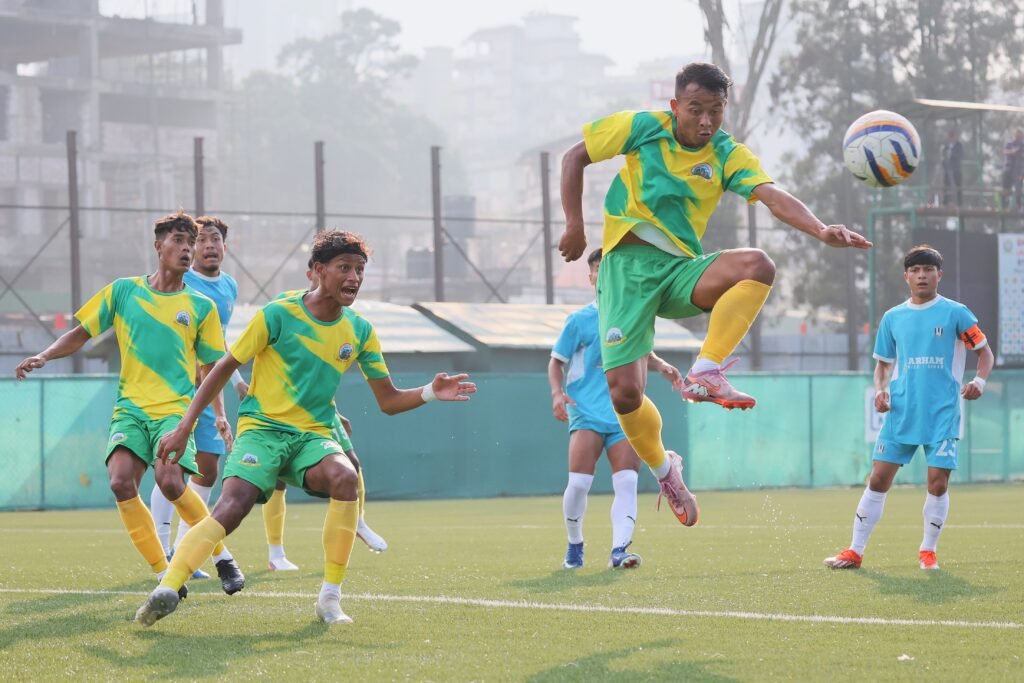
He didn’t actually get to see Mawlai’s match to win the SPL 2026 yesterday but super analyst Bhogtoram Mawroh has had a good look at the club this season and shares his thoughts on what Mawlai have done right and where should they go from here…
After falling at the last hurdle for the past two years, Mawlai have finally won their third SPL title. Unfortunately, I could not watch the game because I was busy earning my livelihood. I had planned to watch a replay of the match later, but I found out that no such facility was available. Although I am a little annoyed, having seen the team play a few games this season I believe I can still share my views on their campaign and what might lie ahead for the players and the team.
Sir Alex Ferguson famously once stated that attack wins you games but it is defence that wins you titles. Nothing epitomises Mawlai’s season more than this insight shared by one of the greatest students of the game. Indeed, the team under Hering Shangpliang does resemble Sir Alex’s teams in some ways – solid, fearless, attacking and possessing a tremendous work rate. There is also a little bit of Arsène Wenger in the way Hering tries to inculcate a one-touch philosophy in the team. From the description I have read of the match, it seems that it was this one-touch football that destroyed Rangdajied in the first half, when Mawlai scored three goals. After that, it was always going to be difficult for Rangdajied to make a comeback and they eventually lost by a scoreline of 5–0.
Before turning to Mawlai, something must also be said about Rangdajied, which has been a stalwart of Meghalaya football for many years. It is one of only three teams from Shillong to have played in the I-League and it produced one of the most gifted and accomplished players from the state in the form of Eugeneson Lyngdoh. However, except for the 2013 season, they have been unable to win the SPL title despite coming close multiple times. In my personal opinion, I would attribute this to what, until recently, we would have called the “Spurs Syndrome”, which was associated with Tottenham until they won the UEFA Europa League on 21st May 2025, giving them their first trophy in 17 years – specifically, 6,296 days.
Having watched them play this season, I still do not think that Rangdajied are ready to win a trophy. But even though they may not win a match, I think they are still a difficult team to beat. The dogged manner in which they played to stop Mawlai from winning the SPL last season was indicative of the quality the team possesses. But the way in which they capitulated against Mawlai yesterday – albeit while not playing many of their key players – to hand them the trophy this season also shows that they still have a long way to go in building a team capable of challenging for trophies. This is despite the fact that they played in the SSA Super Cup final last season, in which they lost to Lajong.
One could argue that the team is trying to groom youngsters and that, therefore, results might suffer in the short term. But Mawlai built a young team from scratch after losing many senior players and they almost won the SPL last year before eventually doing so this season. So, how did Mawlai achieve something that Rangdajied could not even after more than 10 years? I put this down to Hering Shangpliang’s coaching and the confidence he gives his players.
If Hering chooses you to play in his team, you are expected to do one thing above all: run as if your life depended on it and keep running until the final whistle. This style of play obviously demands a lot from the players, but it also instills a never-say-die attitude in them. For me, the best example of this was the game against Sawmer. In the first half, a ball was played behind Mawlai’s right side, and Sawmer’s attacker, Banteilang Lyngdoh, had already got in behind the defender. However, he decided to give up on chasing the ball without even trying. Later in the same half, the same situation happened with Mawlai. This time, however, Basuklang Bina chased an almost lost cause and was able to keep the ball in play: same situation, two different outcomes. Mawlai had already scored a goal, and Basuklang could have chosen to conserve his energy, but he chose not to take the easy way out.
However, a very high intensity can also mean a lack of control, in that instead of managing the game, the team is always trying to create another scoring opportunity. I do not think this is a bad tactic against comparatively weaker teams, but taking the sting out of the game against much better teams is also an important skill, which is an intrinsic part of game management. The only team that can do this against anyone in the league is Shillong Lajong and this stems from a very simple philosophy they follow: play as a team and not as a collection of talented individuals.
In the game against Langsning, Lajong initially lost many balls in the middle of the park. But this was not because they made unforced errors. Rather, they were put under immense pressure, especially by Chusrang Ch Sangma, who had an excellent game. But once the game settled, especially in the second half when the intensity of the press diminished, it became difficult to dispossess Lajong’s players. Players, especially Riborlang Lyngdoh Lyngkhoi, use their bodies very well to shield the ball, and they are always looking for options to pass rather than simply keeping possession. Samchaphrang Lato’s role then becomes very important as the deepest-lying midfielder. He is almost always available for a pass from a teammate under pressure and he keeps the game ticking with his control and passing. Here again, everyone is passing the ball to their teammates and I do not remember many occasions when Lajong gave up possession because of an unforced error. Langsning, on the other hand, lost the ball quite a few times, with Samuel Phawa being the guilty party in a couple of occasions. This may sound very simple, but knowing when to release the ball and having players in the right positions to help a team mate is not a simple skill. In my opinion, it is this simplicity that is Lajong’s biggest weapon, apart from the technical ability of their players.
Mawlai is also a team that does the simple things very well. They move the ball quickly, and all the players work very hard to get into the right positions. High-intensity games are where they excel and they are the most dangerous team when it comes to attacking with pace. But their insistence on almost always going through the middle is sometimes a little frustrating. Their style of play reminds me a little of the early years of Jürgen Klopp’s Liverpool, when the team played with high intensity and pressed their opponents relentlessly. Over the years, the team continued to play with intensity but they also became more adept at playing with a calmer approach and, in the process, became a more complete team. I believe Mawlai has to evolve to that next stage and there are already signs that they are on the right track.
Mawlai have played with different formations in specific matches and have varied their approach depending on their opponents. Sometimes they have changed formations within the same match. But one thing that has remained constant is that they have always tried to play the game on the front foot. During the early part of the game against Langsning, Mawlai kept an extra player in the opposition half to force the deployment of extra defenders and create the possibility of a quick counterattack. But once they almost conceded from a corner, they decided to withdraw the extra attacker, Robertson Khongriah, and put him in defence. During the same match, they also switched from a back three to a back four, highlighting the tactical flexibility and adaptability of the players.
One player who epitomises Mawlai’s grit and determination while driving the team towards the trophy is their captain Damanbhalang Chyne. He was the only bright spark in the match against Lajong in 2024, in which Mawlai were completely outplayed by their opponents. He missed the entire 2025 SPL season as he had signed for a Calcutta Football League club but came back to play in the Meghalaya State League, where he scored a lot of goals. Again, he was one of the few players who did quite well in Mawlai’s maiden I-League 3 campaign in Manipur. But that campaign also showed the inexperience of Mawlai’s young team at the national level. I feel the team is still growing and evolving and they have ridden their luck to win the SPL trophy. But it is also true that winners make their own luck and Mawlai certainly did that. Damanbhalang’s versatility and leadership played a great role in this. In fact, I think that in next year’s National Games he should be the vice-captain of the state team, with Hardy Cliff Nongbri as the captain.
Mawlai have other versatile players as well. Ricky Chyne has played mostly in midfield, but he has also played as a centre-back. Wadshwa Latoo has played in both full-back positions, while he has also played as a winger. Jestibor Mawlong’s main position is left-back, but he scored the decisive goal against MLP while playing in midfield. In an almost unchanging defence, Arkibor Makroh and Arkini Laloo have become a solid partnership, supported by Lambhamiki Lamare in goal, whose fingertip save from a Bickyson Kharkongor strike was one of the best saves of the season.
But perhaps the most precocious talent among all of them is Kevin Rymbai, who did not start many games this season. Judging from the little I saw him play this season, I feel his lack of game time has to do with the fact that he looks a little too casual whenever he has played. Granted, he has the talent, but Lovingstar Suting, Basuklang Bina, Fairming Suting and Samlang Rympei work harder than him. In Hering’s team, hard work is paramount.
Kevin’s situation reminds me a little of Alwyn George, who was the captain of Pailan Arrows, the AIFF development team, and one of the most gifted Indian footballers I have ever seen. There was one particular occasion when Pailan Arrows came to Shillong to play against Lajong. The players, many of whom later went on to play regularly for India, such as Pritam Kotal, were practising among themselves and they were all mesmerised by Alwyn’s first touch and skill. He was a huge talent. But despite having played for India a few times, Alwyn never lived up to his potential and arguably less gifted players had longer and more successful careers than him. Kevin has the potential to achieve great things, but he must have the attitude as well.
Now that Mawlai have won the trophy with a young team, they have to build on this success by strengthening their squad. By that, I mean that the players have to get more experience of playing at a higher level. Therefore, although winning the SSA Super Cup and SSA Champions Cup should be the next priorities, they need to win the MSL and try to get another shot at I-League 3. Since they have won the SPL trophy, they should, I hope, get the opportunity to participate in next year’s Durand Cup, which will be another important experience.
Ambition, ambition and ambition is what Mawlai need in order to evolve. That is the only way they will join their counterparts: Lajong are already playing at the highest level; Nongkseh are going to start their journey towards reaching that level later this month in I-League 3; and Langsning will come back stronger. What will Mawlai do? For the time being, they must enjoy the success they richly deserve. So, a hearty congratulations from me, and I hope they will continue to improve.
(Shillong Sports Association photo)