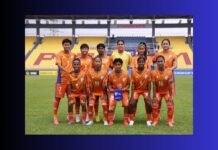
It’s been a while since we’ve heard from Bhogtoram Mawroh but here he is at the end of the year to comment on Meghalaya’s qualification for the Santosh Trophy 2025-26 final round, which came about through that heart-stopping match against Arunachal Pradesh before Christmas
Football is a game of passion and emotions can change very fast. From anger and frustration just a week ago, it was all relief and ecstasy as Meghalaya defeated Arunachal Pradesh to qualify for the second round of the 79th Santosh Trophy. It is quite unbelievable how the team got itself into such a mess in the first place that it had to win the group on the basis that it scored one goal more than its opponents. At home, and with all due respect to Arunachal Pradesh and Sikkim, Meghalaya should have obliterated its way to the final round.
This is where the beauty of team sports comes to the fore. Individually, Meghalaya has more talented players than either of those teams, for the simple reason that it has players who can win individual duels in defence or attack. Kynsaibor Lhuid is not the only player who can take on opponents and beat them with pace and trickery. Riborlang L Lyngkhoi showcased that he can do the same with close ball control and quick feet. It almost led to the first goal against Sikkim when he weaved past Arunachal Pradesh’s defence and played a through ball to Deibormame Tongper, who shot straight at the goalkeeper, wasting the opportunity.
Then there is a player like Wanboklang Lyngkhoi, who was an absolute beast in defence. What really surprised me was how quick he was, which gives the team a tactical edge if it wants to play with a high line. He looked like a strong defender when he was playing for Mawlai, but he has transformed into an absolutely colossal player since leaving the club. Last year, he played for Bodoland FC in the 2024 Durand Cup, winning a Man of the Match award in one game. This year, he participated in the 2025 Durand Cup playing for the Indo-Tibetan Border Police, which also featured Donborlang Nongkynrih – another player with a big heart – alongside him.
So, while Meghalaya were superior in terms of individual players, teamwork was completely missing in the first game against Sikkim. Meghalaya did score the first goal and they created a lot of chances in the second half while chasing the game. However, before the late surge, they allowed Sikkim to grow into the match by giving their players too much time on the ball. With Sikkim dominating possession, Meghalaya were put under enormous pressure and mistakes were inevitable. Despite what looked like a goal-line clearance, Sikkim scored their first goal and a mistake by Arlangky Nongsiej led to the second when a mispass gave the ball to Surag Chettri, who finished past Meghalaya goalkeeper Nister Roy Suting.
When you watch teams in the Shillong Premier League, one thing becomes very clear: game management is sorely lacking in their repertoire – not against weaker teams but against good ones. By this I don’t mean sitting back and defending after scoring but controlling the game by depriving the opposition of the ball, forcing them to push forward and create spaces to attack. The best example of this was the Shillong Lajong versus Mawlai game, where Mawlai scored three goals but still ended up losing 4-3.
What Mawlai should have done was control the game in midfield by slowing the tempo, forcing Lajong to inject pace into the game, which would ultimately lead to mistakes. But Mawlai are not the only team that struggle to control games against strong opponents. Teams from Shillong thrive on pace and tend to play the game in fast-forward mode. Players are always looking to attack and without the ball they often look lost unless they press aggressively to win it back quickly, as they did against Arunachal Pradesh.
Lajong are the only team that can control games against good opponents but even they struggle when they don’t have the ball. This was evident in the SSA Champions Cup final, when Nongskseh managed to control the game for brief periods and Lajong looked vulnerable. This issue carries over into national championships as well, with the Santosh Trophy 2022-23 final between Meghalaya and Karnataka being the best example, where Karnataka dominated possession. If Meghalaya want to do well, they must ensure control of possession and aggressive pressing is the only way out. That is how the game against Arunachal Pradesh was won.
Forced by circumstance to win by scoring at least two goals to qualify, a change of tactics was inevitable. Led by Hardy Cliff Nongbri, who had a sub-par game against Sikkim, the team was relentless in its press and piled on wave after wave of attack. The midfield trio of Hardy, Iohborlang L Lyngdkhoi and Mebanshngain Kurkalang had a good game, but I still don’t think Mebanshngain is a midfielder. From the few games I have watched, he looks like a very good centre-back. But he was played in midfield by Rangdajied United in the Super Cup final against Lajong, which was one of the worst finals I have seen. I was genuinely upset watching him play there. Although he did relatively well, he is not a long-term solution in midfield. It should have been Hamedamanbha Wahlang who started in the first place. When Meghalaya scored the second goal and substituted Mebanshngain, I thought Hamedamanbha would be brought on. Instead, Dibormi Kassar, another Rangdajied player, was introduced.
My biggest fear was that once Meghalaya scored the second goal, they might drop off and allow pressure to build, which would be dangerous. Eventually the goal did come for Arunachal and things became tense in the stadium. But the team held on in the final minutes, securing a place in the second round.
The win against Arunachal was the result of the collective hard work of the entire team but a few players stood out. Kynsaibor Lhuid’s dribbling was the highlight of the match and at times he looked untouchable. The first time I saw him play was when he joined Langsning, forming a formidable partnership with Kitboklang Pale and, for a while, he played in the latter’s shadow. Over the years, however, he has developed into a very effective player, although at times he tends to overcomplicate things – especially his passing. Instead of making a simple pass, he often attempts a clever one without his team mates anticipating it. Comfortable with both feet, he scored a beautiful goal in the I-League while playing for Lajong. He also played for United SC and is now back in Shillong with Nongkseh, whom he helped win the Champions Cup by scoring an equaliser in extra time.
Hardy has always had potential since breaking into the Lajong team, but I felt he was never given the opportunity he deserved. He returned stronger, regained promotion for Lajong through I-League 2 and captained the team for two years before joining Nongkseh. His goal against Lajong, his former club, won Nongkseh the Champions Cup title, which must have been a bittersweet moment. His performance against Sikkim was disappointing, but, as always, he proved his detractors wrong with a masterful display against Arunachal. If Meghalaya want to progress further, he must continue leading by example and cannot afford another poor game.
The defence – comprising Wanboklang, Iohborlang, Mebankhraw Wahlang and Apborlang Kurbah – was solid, although Mebankhraw looked a little slow at times. Wanboklang, as already discussed, was colossal at the back. The player who truly changed the game, however, was Apborlang. He was one of the last defenders and the first to attack, showing incredible energy, enthusiasm and commitment throughout the match. His headed assist led to one goal and his bullet strike won the game for Meghalaya. A Lajong product, Apborlang seemed to be in the wilderness for a while but this year he won the SPL with Langsning. He performed well in the previous match too and displays like this should give him the confidence to improve further.
Although not overly tested, Nister had a couple of heart-in-mouth moments – once when he tried to beat an attacker with his footwork inside the box and again when coordination between him and the defenders broke down. This year’s SPL featured some excellent goalkeepers, with Wanteilang Malngiang (Lajong) and Banshanskhem Kharsyntiew (Mawlai) performing well for their teams. However, in the First Division with Meghalaya Police Nister was the standout player and I was hoping he would get the nod for the Meghalaya team. A good shot-stopper who is confident under high balls – choosing to catch rather than punch – what truly sets him apart is his distribution. If he weren’t a goalkeeper, he could easily play as a deep-lying playmaker. For me, he is a player to watch in the future and, hopefully, he continues to improve.
Meghalaya are now in the final round and there are lessons to be learned from these games. They cannot allow teams to control matches against them, as that will spell danger. Start ferociously, get a goal, then control the game with the ball, not without it. When spaces open up, attack with intent, score again and repeat. That would be my suggestion.
So, all the best to the team and thank you for a positive end to the year.
(Meghalaya Football Association photo)